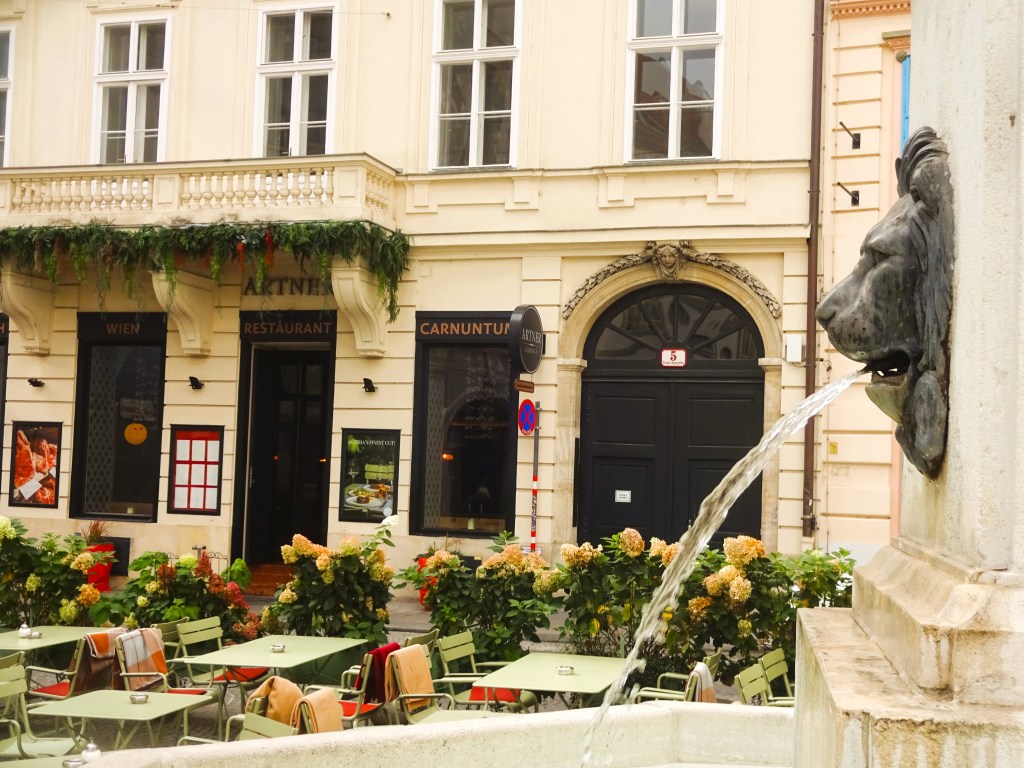
Oh Vienna!
A four hour delay on our night flight from JFK, though Austrian Airlines had a good excuse as a passenger had a medical emergency and had to dropped off in Shannon, Ireland along the way!
Eventually we all boarded after great patience. A very efficient and comfortable flight. For once we didn’t bother with in-flight entertainment – we were too washed out!
We arrived at beautiful, spotless and laid-back Vienna Airport in the afternoon. We got Vienna Weekly Passes at 29 euros each for the whole week, for underground metro, bus or tram. The Vienna City Pass wasn’t necessary as we didn’t need free entry to 90 museums and city attractions.
Vienna’s public transport system is exactly like Berlin, and so, so easy. You never have to use the ticket to get through any barrier. You’re simply required to have it to show if a ticket inspector asks to see it onboard. Of course everything is sparkling clean.
In a lot of beautiful European places there is nevertheless lots of graffiti. I remember that in Spain. Marie and I don’t mind at all though. Our taxi from the airport to our Ruby Lissi Hotel provided lots of graffiti to look at the side of the main road and on bridges, including one large one duplicated several times that simply said “f%*# cars!”.
We arrived at 4pm. Our hotel is part of the Ruby chain. Next to the hotel is a gin parlour with over 500 gins, and surprisingly a Petscan medical centre. The entrance is a corridor from a former central post office kinda…thing and odd like some dream scene from ‘The Prisoner’ tv series or something but we liked it! Most side doors blocked off and not used anymore. Like a speakeasy hotel? Ish.
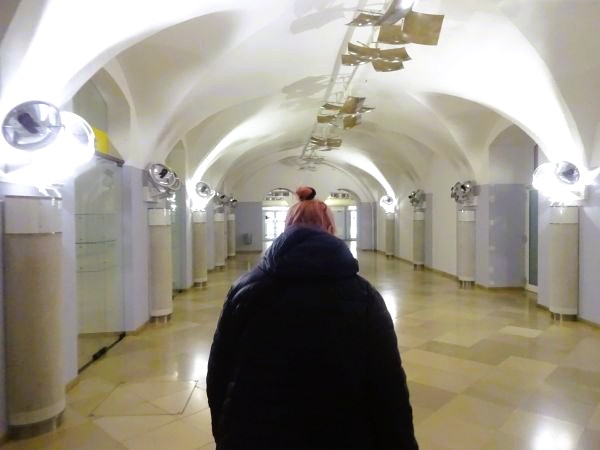
Then we were mightily impressed to find lots of warm and cosy, large and attractive bars and lounges in the hotel itself, choc full of old world themed décor and motifs and chandeliers! We were a bit less impressed that it was required to check yourself in on a screen by the bar. Marie did that for us, but we were both of course lagged and it was a long, fiddly form.
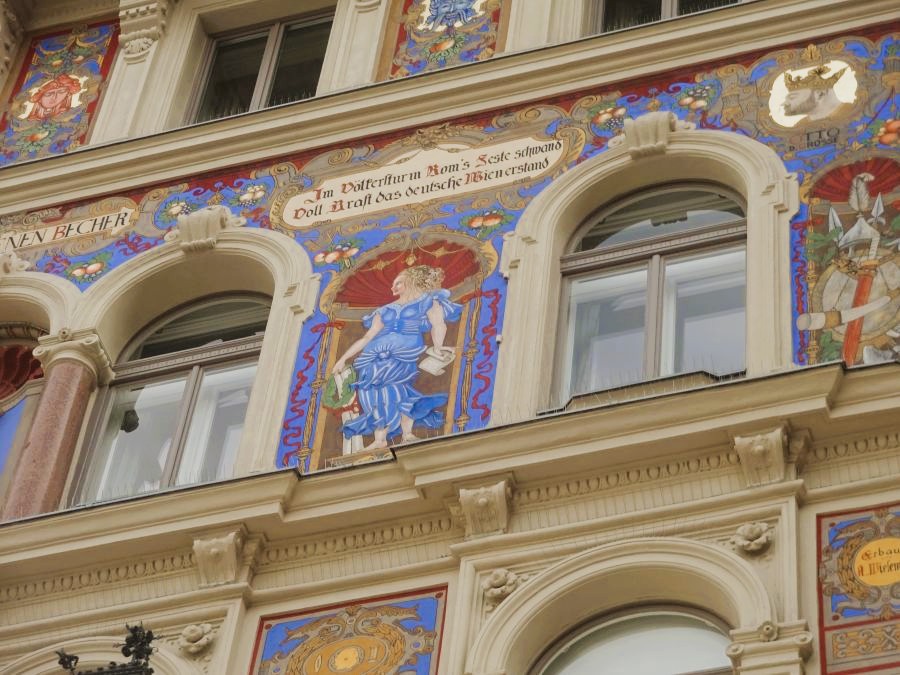
We freshened slightly and went out to explore. Everything was elegant, atmospheric and just how you imagined Vienna would be! We loved the part near our hotel. As we walked further, only the main drag running alongside Stephansplatz was clunky and full of tourists but duck down any side streets and it quickly becomes enchanting again. Architecture and decoration can be amazing anywhere though.
For our first Viennese meal we had reserved at Purstner in the evening. We absolutely loved it! Family run and very friendly, all vintage dark wood and playful character. Multiple, amazing rooms (A.I says “hunting lodge style”) but very popular so we were glad we’d booked. We were sat at a Gothy corner opposite a table tucked into a giant wine cask. Our waiter was very jolly, and helpful. We ordered up a delicious large veal schnitzel to share, followed by a British style pancake with apricot jam. Marie a white wine and myself a beer.
Afterwards Marie thought she heard “Harrogate” (Yorkshire) accents at a nearby table, but the very chatty group were from Manchester. They were returning to Purstner for the last meal of their trip tomorrow too.
As we walked around a little more before bed, Marie was delighted and amazed that in one shop was a real “doggy in the window”! She was in love, though the dog had either been trained to look away with an aloof air or was simply too used to attention!
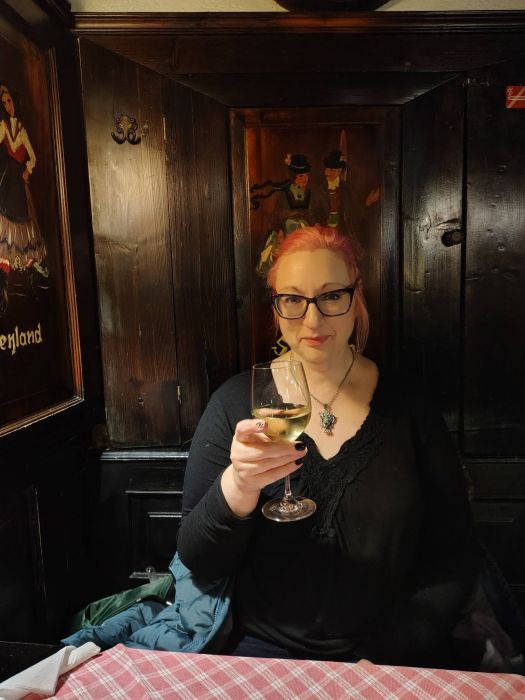
At Purstner, above
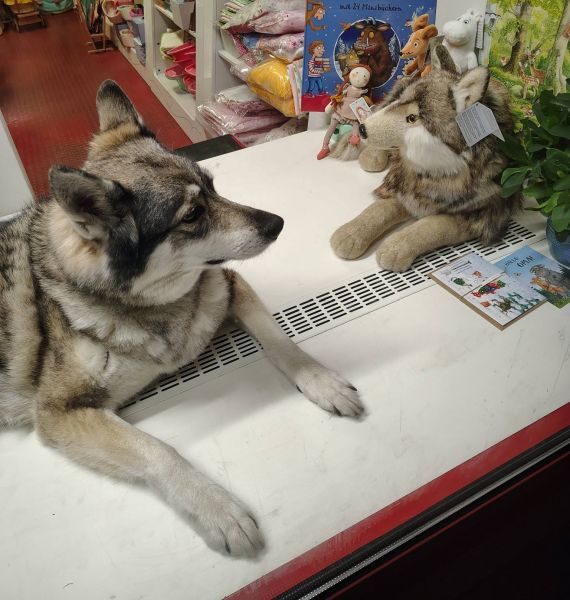
Yes, the real alsatian (German shepherd) is sat opposite a stuffed toy one – who says the Austrians lack a sense of humour!
Oh, and we finished with cocktails at the bar in the hotel!
Day one (first full day in Vienna, Sunday)
Breakfast at nearby Cottage Roasters – I know, such an Austrian name – with strong coffee, croissant and apple strudel. “Would you like vanilla sauce?” from the serving girl. It turns out it’s like a milder, thinner English custard! I think this was to be our only strudel of the trip (quite nice, though there are probably better examples in the city).
Next up, back out on the streets Marie posed next to an advert of a girl with similarly pink hair to her, we passed a “teddy bear’ museum which was more like a shop window crammed full of t-bears, and with one in a car driving over another teddy bear (road kill!). And then we wandered over towards Stephansplatz with its impressive cathedral. We did think that Stephansplatz would be much more elegant than it is though. Whereas we love the quieter areas way more, and there are just far too many tourists on Rotenturmstrasse. We went into the slightly crowded St. Stephen’s cathedral, where mass was being given.
This afternoon we had reserved seats at Burg Kino (Burg Cinema) to see ‘The Third Man’ classic film, with Orson Wells and Joseph Cotten from the 1940s. I’d always loved it, and Marie had watched it for the first time at home with me a few weeks ago and enjoyed it too. The zither music in it stays with you forever once you’ve seen it. We carried on walking, and Marie showed me “Harry Lime’s apartment” from the film, at number 5 Josef’s Platz. Amazing to see these and other locations from the film!
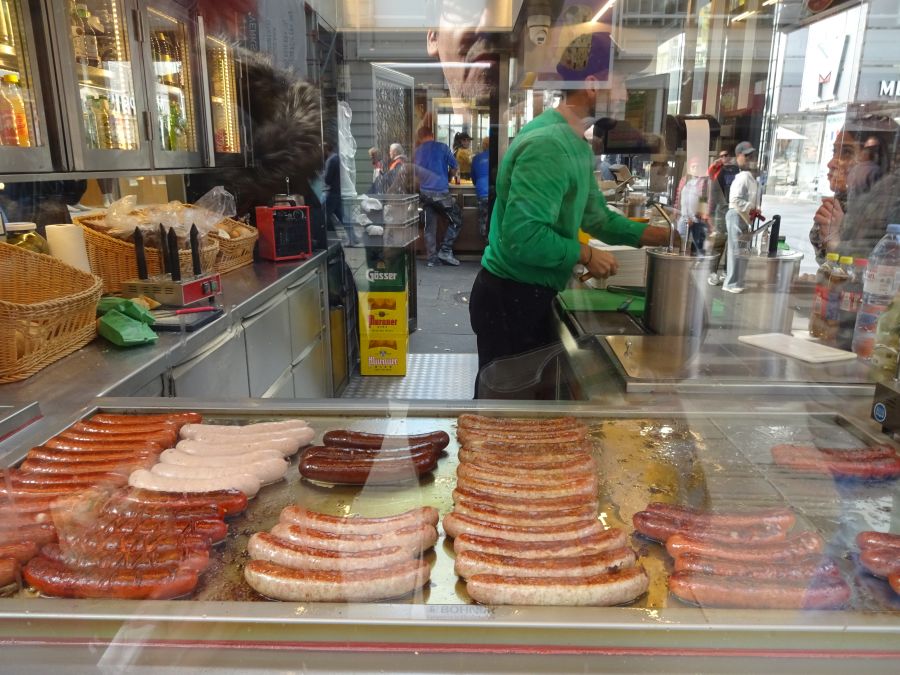
And then to our first Vienna frankfurter and wurst stand. You imagine (if you eat meat) that you might tire of sausages, but they are outstanding. We devoured two, with buns, and loved the one with the cheese the most. Every wurst has that crispy pop on the outside. So good! Somewhat in contrast to New York hot dog stands, they also serve champagne!
We walked around quite a bit next, and sat in Burg Garden Park, which is well known for its Mozart statue. Also, a musical cleft today, made out of flowers.
Then a bench break, whilst waiting for the movie. Burg Kino is a very old cinema, though feels very much like a Communist era 1970s in a charming way.
We got snacks, and waited by the wrong entrance and only realised just as the film was starting it was in the other suite! We entered pretty much in front of the screen just as the zither strings were being plucked at the very start.
Most seats were taken. We enjoyed it as much as ever, but on a bigger screen noticed details we’d missed before. Marie loves the film even more now (though her favourite is the other Austrian classic, the very different ‘Sound of Music’).
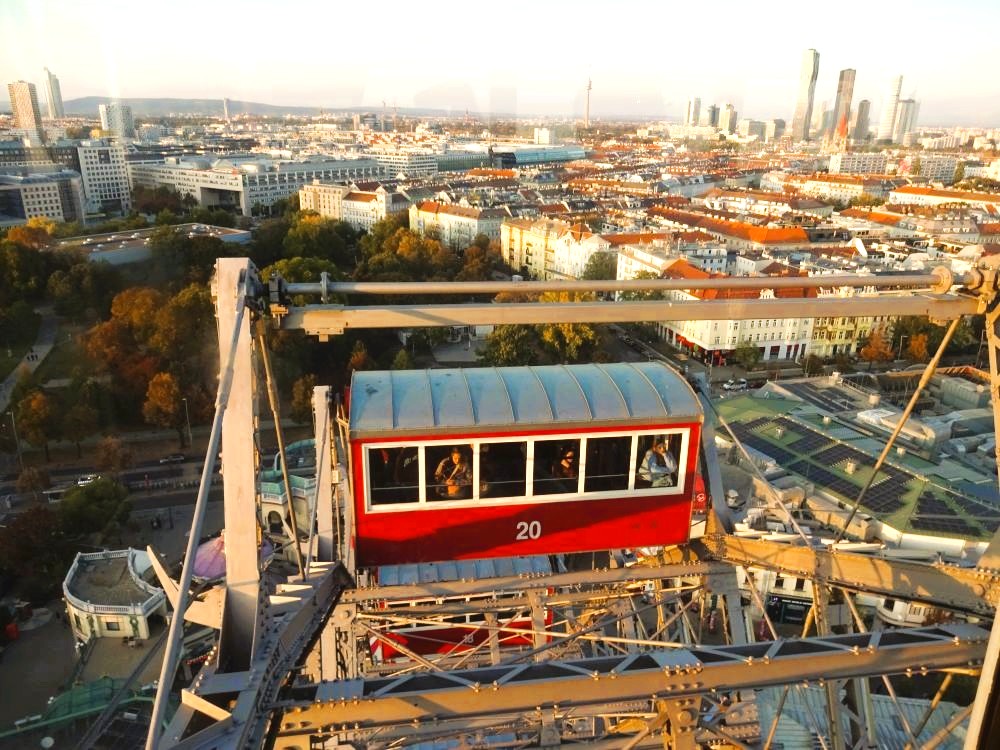
In the Third Man, there is a famous scene on the big wheel in Prater Fairground park. Harry Lime (Wells) is threatening to throw Holly Martins (Cotten) from the top of the wheel.
Naturally one of the things we did next was head straight to Prater on the U-Bahn (metro). We did indeed ride the big wheel. Prater park is huge, probably the biggest fairground we’ve ever seen including the Disney ones because Prater has far more rides. Thanks to me, we didn’t go on any more (Marie would do some of the more mid level white knuckle rides…I’m scared of those, whereas I’ll happily do any Halloween fright run or any ghost train but Marie is equally afraid of those!).
Then to Schweizerhaus Beer Garden within Prater, where we ordered up the infamous pork knuckle with the best and most generous crackling ever! A white wine for Marie, a giant beer for me.
Thinking about crazy golf next but it was closing, so instead we played some classic carnival style games like Skee and a shooting game.
We rounded out a crackin’ day with a visit to a local bar, mostly or all locals. The juke box was being used constantly, mostly dance music.
A few photographs from the day…
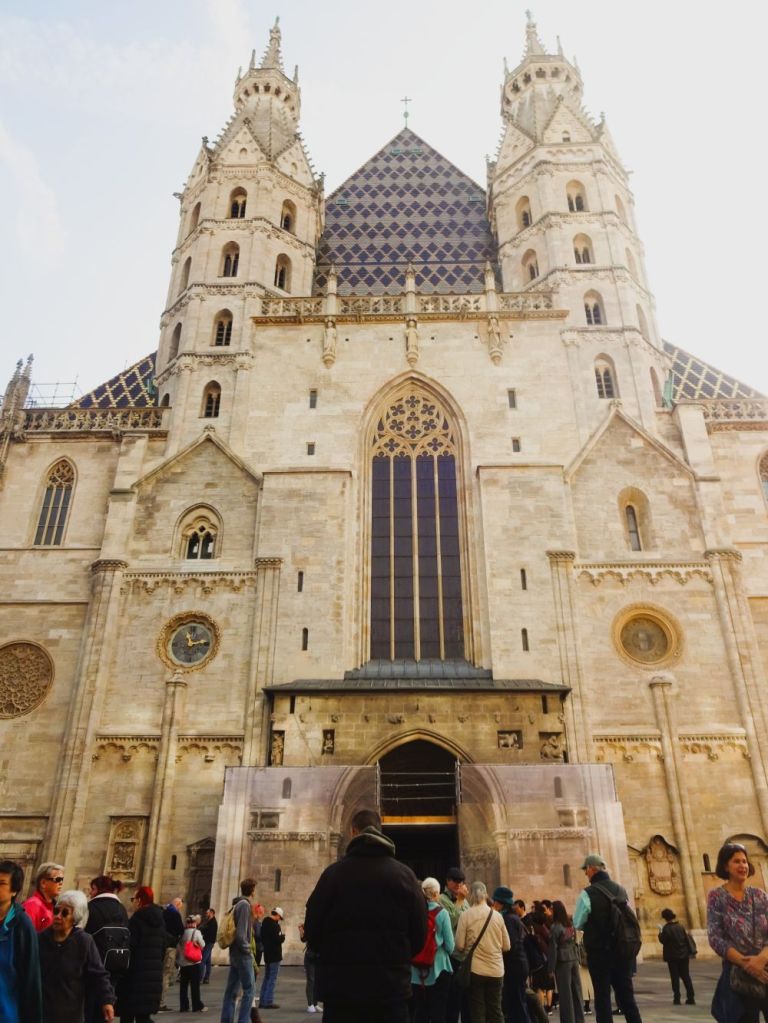
St Stephen’s Cathedral
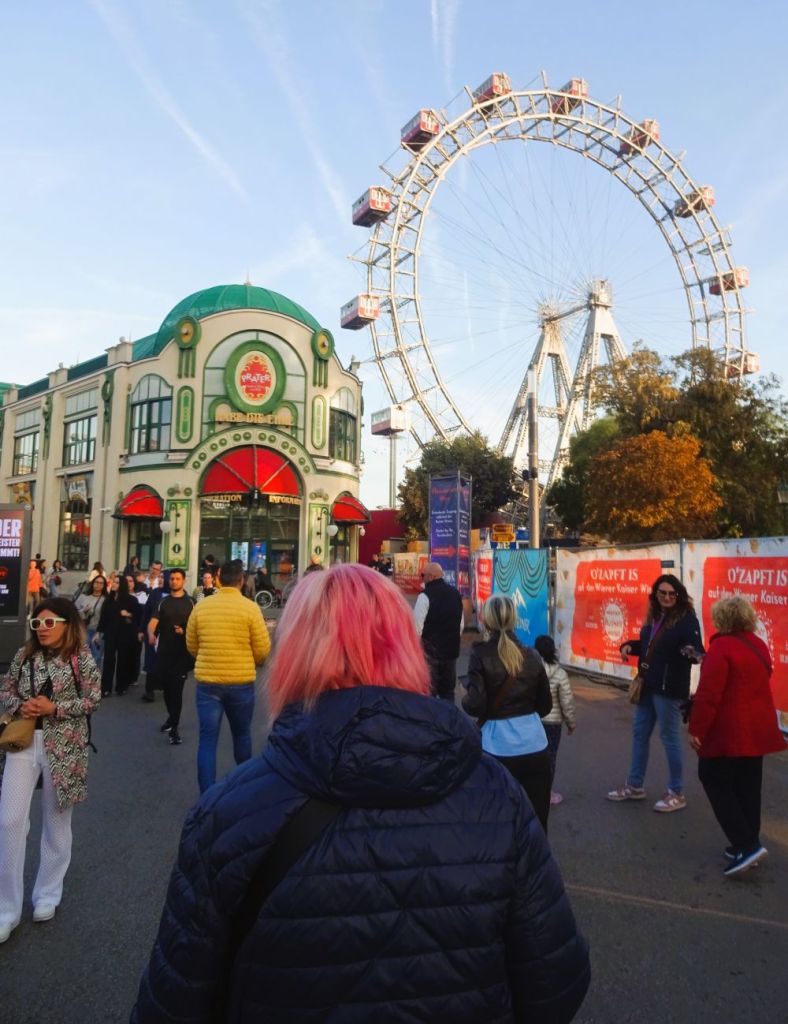
Prater
Day 2
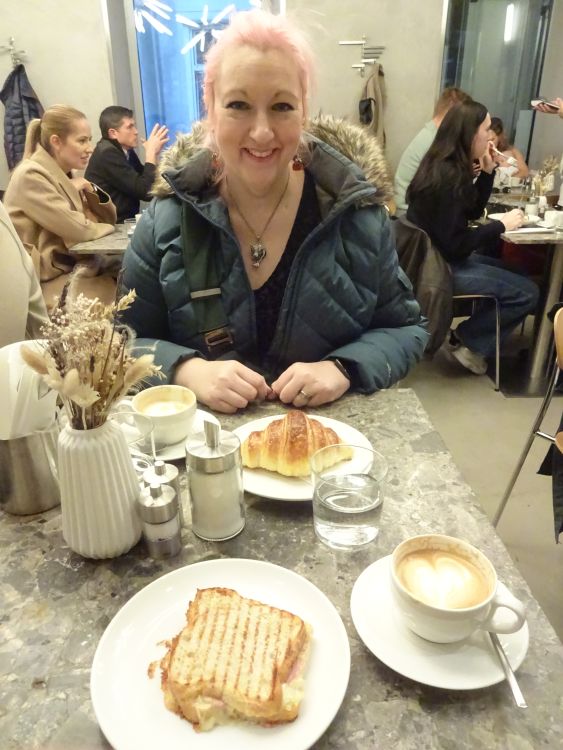
I’d read an ex Pat local’s online recommendations, and the woman recommended Offerl as one great breakfast place. A small chain. So we tried there. Really lovely staff (the young woman serving at the counter admired Marie’s sparkly crocs). The sandwiches and cakes in the case at the front looked top quality. We got taken to a table at the back, Marie having a croissant and myself a fine ham and cheese toastie, a standard well above the usual (crispy sandwich base too!).
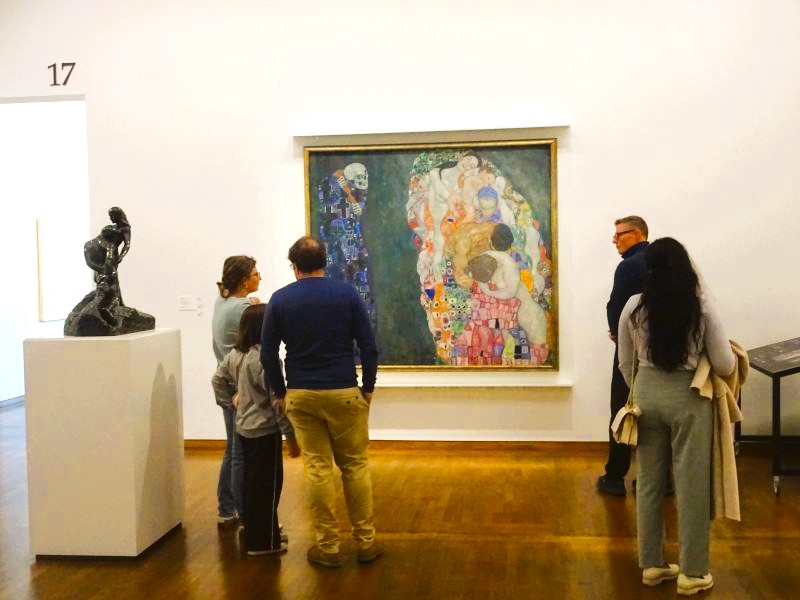
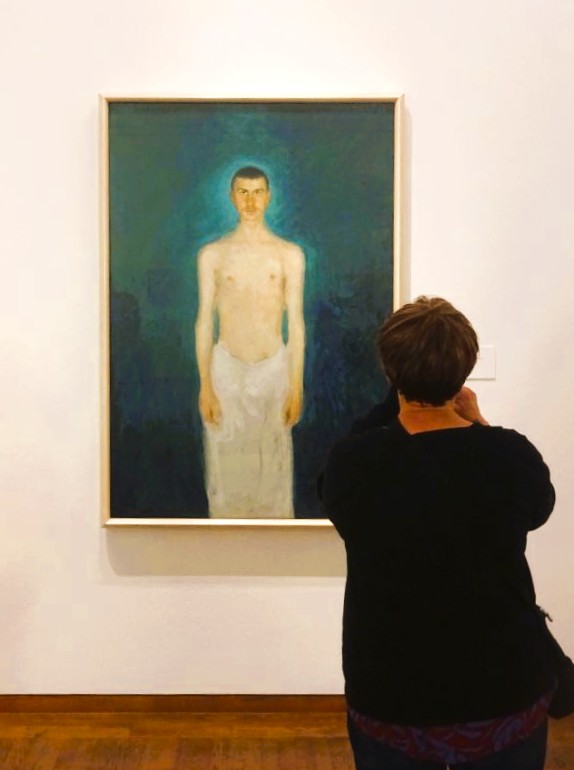
Then the U-Bahn to the Museum District. Before the trip I chose the Leopold Gallery to see some Gustav Klimt paintings. Klimt is the Austrian artist whose work is highly decorative, and often use gold leaf in his stylized portraits. ‘The Kiss’ is his most famous work. Here they had lesser-known works. Also a lot of Expressionist paintings, Egon Schiele and other moody, distorted and dramatic, Austrian Expressionism. I also liked the Richard Gerstl stuff. We enjoy galleries and museums much more than we used to!
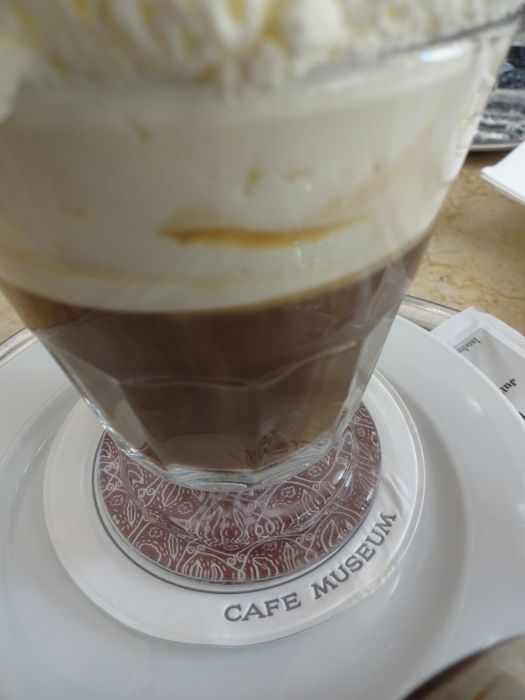
An airy, interesting walk through very decorative arch ceilings to another classic cake and coffee cafe. ‘Cafe Museum’ is not in a museum at all, but on a street. It began in 1899 and was made much more plush in 1930. Klimt himself used to go there. Although the top Viennese cafes can feel grand, they are very easy-going. This one is a special place. You can also spend a couple of hours here and no one will ever bother you to move on.
We had a trio of small sample cakes, including a Mozartorte and the best-known of all, a Sachertorte which is rich chocolate with apricot jam. A smiling chap (he reminded me a little of Billy Connolly in his fifties) with a shaggy terrier dog sat a nearby table, and Marie was captivated by the dog. That’s something we saw a lot: often big dogs in cafes and restaurants too and they’re all welcomed by the establishment!
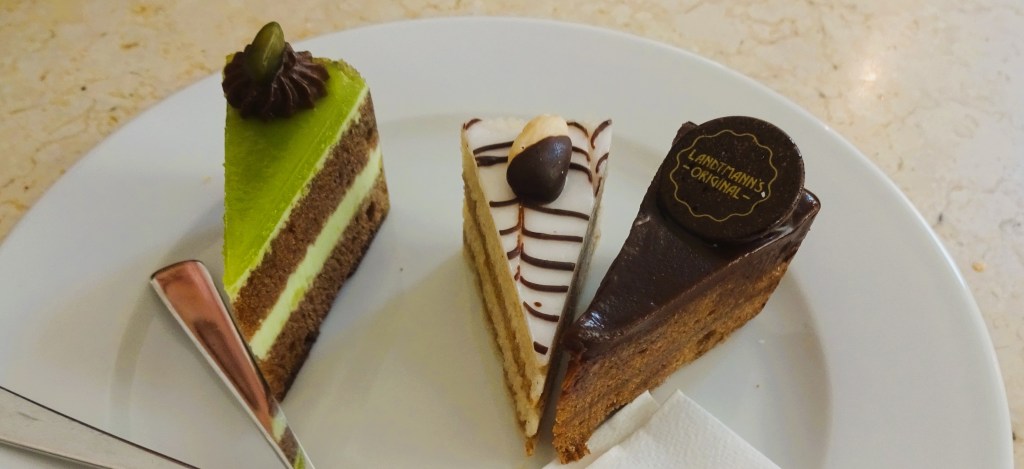
a trio of classic cake samples
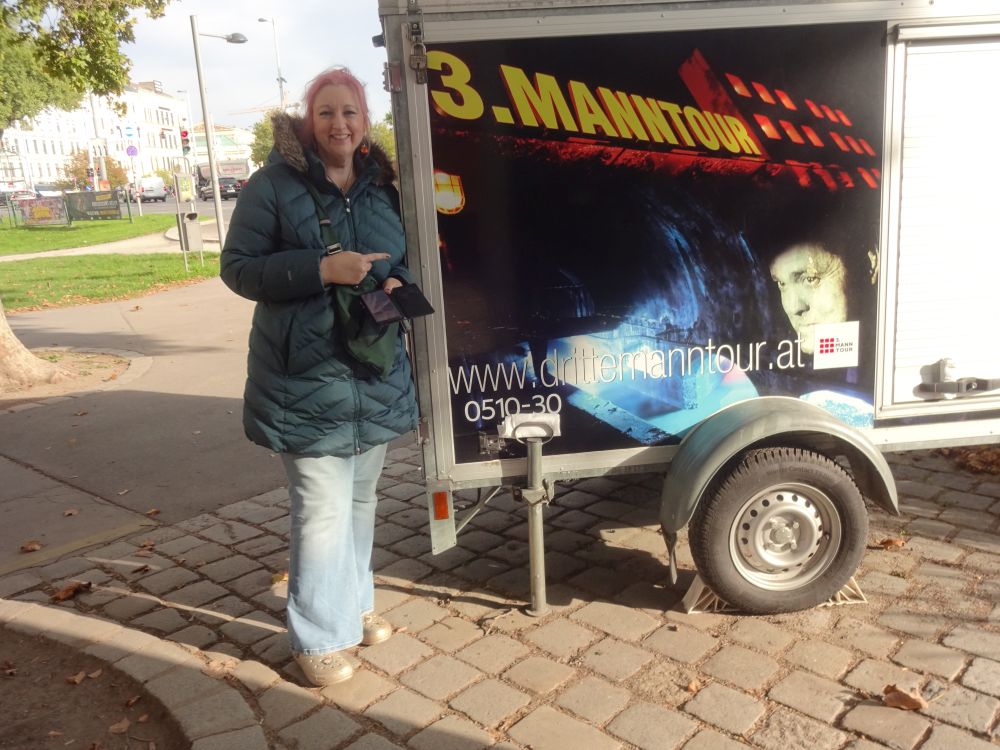
Outside we discovered where the ‘Third Man’ tour begins. Including the film buffs’ favourite manhole cover, where Orson Wells disappears down the sewers. The tour includes the sewers where the villain tries to escape the police lead by Trevor Howard. One to perhaps do on another visit!
Then to what Lonely Planet describes as a charming section of the city in the 7th district, Spittelberg. Marie had researched the best way to walk there through a weave of eclectic footpaths. Spittelberg is one area in which it would be ideal to live and was full of rustic, pretty squares and lots of delights!
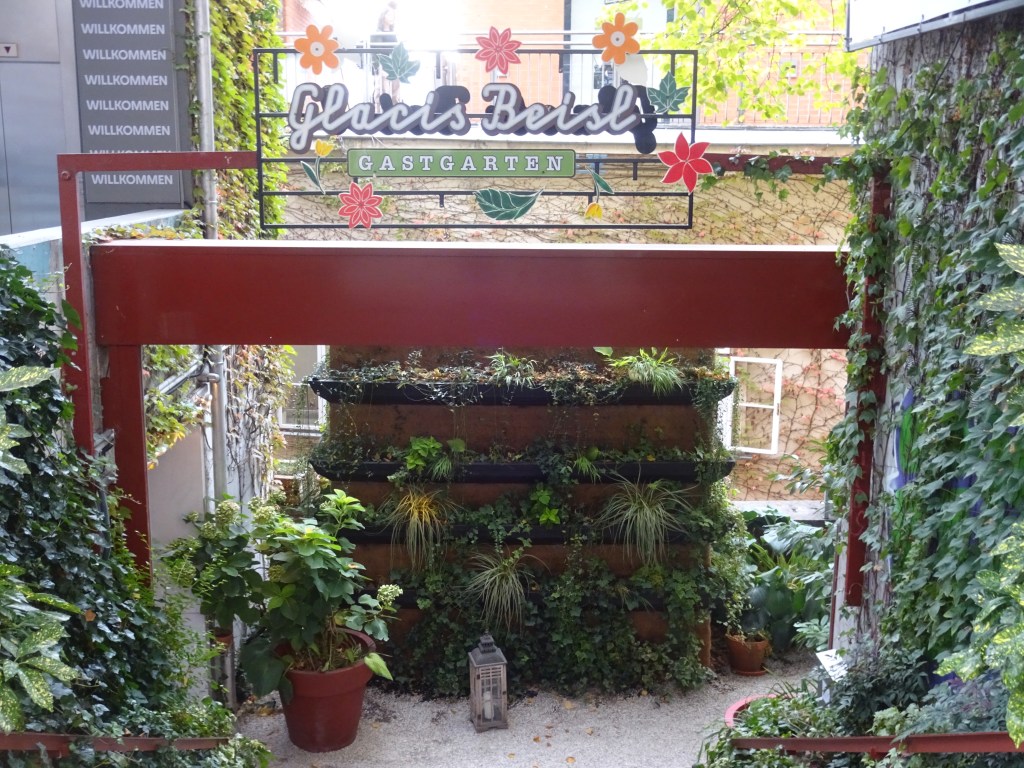
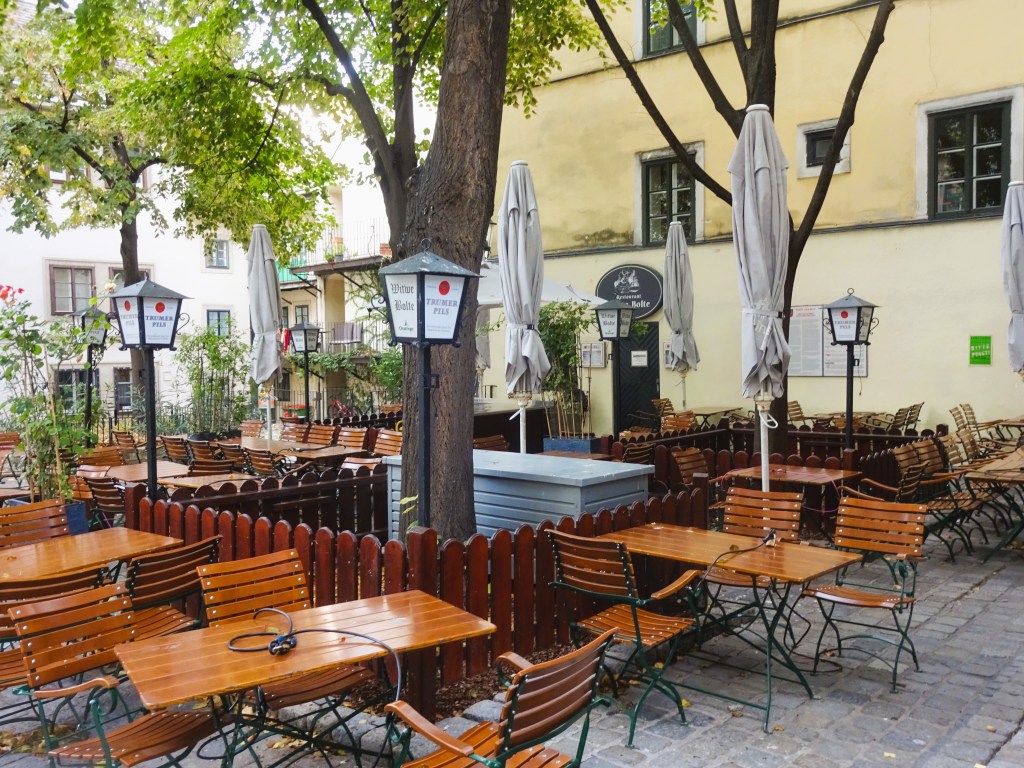
Spittelberg, above and below (traditional beauty and alternative modern)
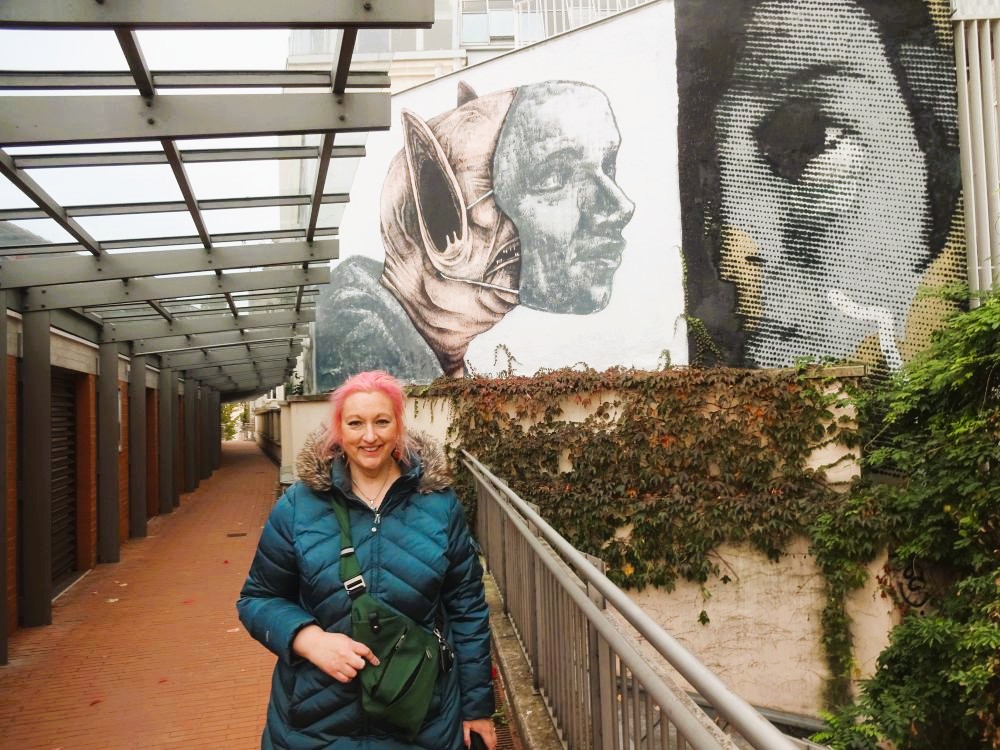
We settled on a cafe – Das Cafe – that Marie found, and which did sturm wine. Sturm is unique to Vienna, and is a cloudy, semi sparkling wine fermented from young grapes but only seasonally. We liked it and the cafe a lot.
Back at the hotel via tram at 6pm.
On the first night we had noticed a quality looking Italian restaurant near the hotel, and earmarked it for later, Rossini. We would be choosing to eat mostly Austrian food when in Austria – we don’t get much of that Germanic cuisine back home – but we’d give the pizza place a try this evening. Being a Monday we wouldn’t need to reserve. The nice, small staff perused the reservations book when we asked. They uhmmed and ahhed…wait a minute. They just about squeezed us in! There were a couple of Brits at the next small table in front us, and Marie was very happy to see an Austrian couple behind with a beautiful dog.
The food was class. A proper pizza oven and Italian cooks. The old guy who took out the Neopolitan pizza clearly didn’t speak German, as he indicated to the waitress it needed seasoning through his mime. We had quattro stagione and spaghetti. Everything had a delicious, light touch as Italian food should really be rather than the gut busting portions back in New York (also delicious, but it’s nice to have the European touch sometimes).
When we got back to our hotel, in the bar was a jazz band and two men (around late 50s/60 ish?) freestyle tap dancing in front of the band! It was a tapdance-off! They were both great. “Showboating” even. A young couple passed by on their way out for the night and didn’t even look round. We thought, “have some sense of wonder won’t ye!”. These sort of things make a holiday for us! It was like ‘Deliverance’ but instead of banjos, tap dancing!
Day 3 – Tuesday
Breakfast at a delightful, pink cafe that we’d had our “mincepies” on – Aida (a small chain). Austrians don’t mess about when it comes to cake, or coffee for that matter!
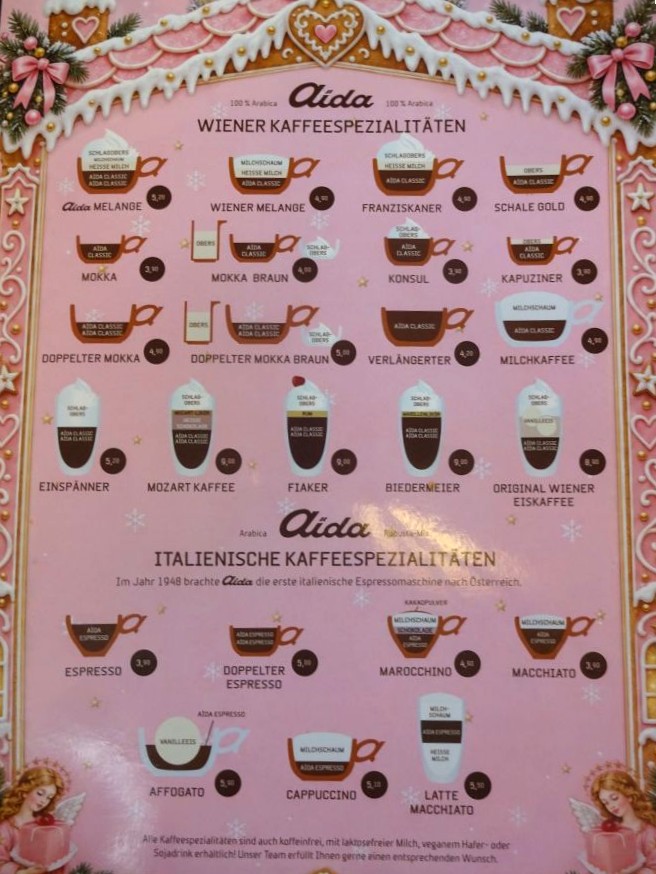
Then we walked to our planned site for this morning, The Hapsburg Imperial Crypt.
I think everyone has a vague knowledge of the Hapsburg royal family, who were dominant in Europe for centuries. The Austrian Hapsburgs ruled from the 13th Century until 1918!
The family was of course full of characters and some did very well, others mixed fortunes or poorly.
Most famous today is the Austrian Empress “Sisi” from the 19th Century who was kind of like the Princess Di of her day and the nation’s favourite. You see her face on tea towels and chocolates and so on today, and there is a Netflix series too.
Anyway, there is a partly macabre and very ornate crypt where 150 of the family are buried so we wanted to go and have a nose at that. It’s under the Capuchin Church.
The Crypt is quite compelling! The family are apparently buried in 3 separate places: the bodies in the crypt, their hearts in urns in the Augustinian Church and entrails in urns and catacombs in St. Stephens.
Most tombs in the crypt are show-off splendid, and spectacular except for the few Hapsburgs who favoured kindness and consideration to the general public manifesto and those are buried in very plain coffins. Though that was often requested by the subject to reflect their “enlightened ideals”. It’s fascinating to spend 45 minutes or an hour there. I’ll add a couple of photos below.
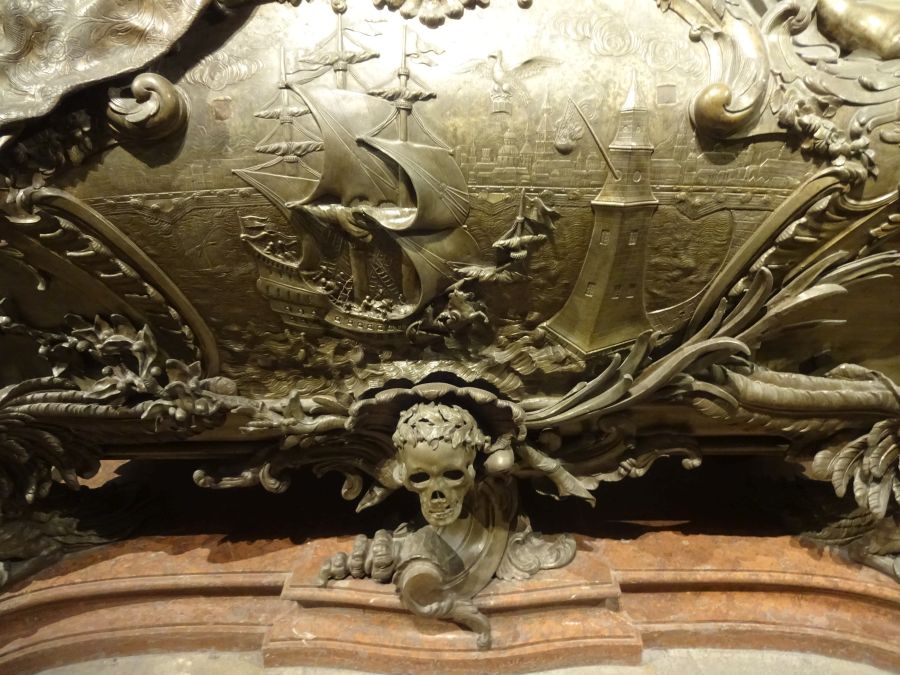
The Hapsburg Crypt
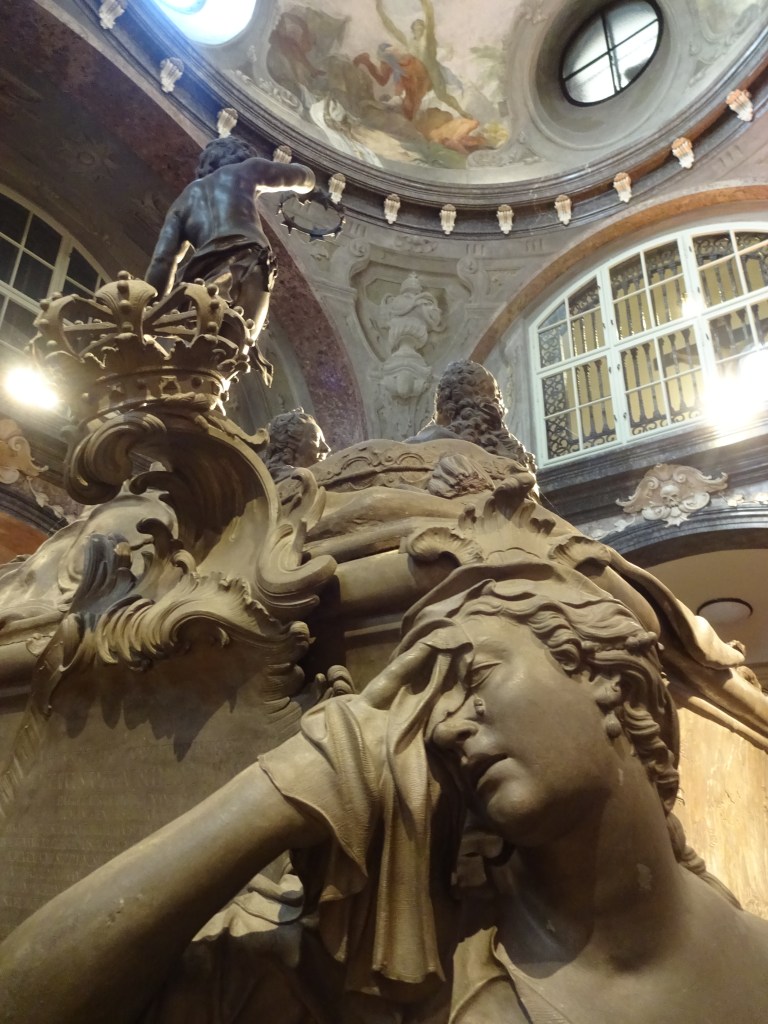
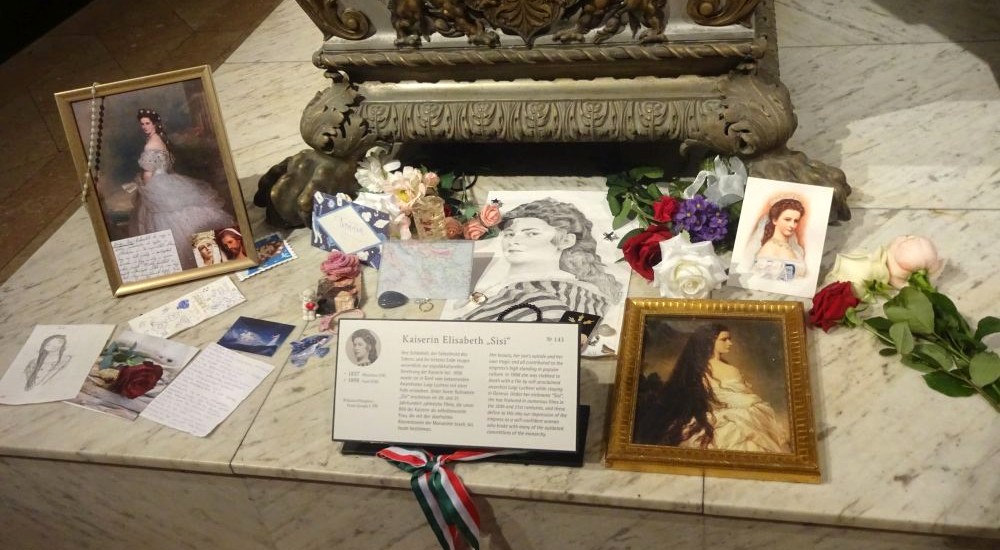
From A.I below…
The “Accidental” Empress: Sisi was never supposed to be empress. Franz Joseph was arranged to marry her sister, Helene, but when the family met, the young emperor insisted on marrying the 15-year-old Sisi instead.
- Resisting the Hofburg: Sisi hated the oppressive Spanish court etiquette of Vienna. She locked horns constantly with her strict mother-in-law, Archduchess Sophie, who took over the rearing of Sisi’s first children, claiming Sisi was too young and incompetent.
- Love for Hungary: To escape the Vienna court, Sisi spent much of her time in Hungary. She became deeply attached to its people, learned the language fluently, and played a crucial role in establishing the Austro-Hungarian Compromise of 1867, crowning her Queen of Hungary.
- The Famous Hair: Her floor-length, thick chestnut hair took nearly three hours to wash and style every day. The styling time was used to learn languages, including fluent ancient and modern Greek.
- Extreme Fitness: Sisi stood 5’8″ but maintained a waistline of just 16 to 19 inches. Every palace she frequented had a gymnasium installed. She practiced intense daily gymnastics, rings, and went on rigorous, rapid-paced walks lasting several hours.
- Assassination in Geneva: On September 10, 1898, while walking to a steamship in Geneva, Switzerland, Sisi was assassinated by an Italian anarchist named Luigi Lucheni. He stabbed her in the chest with a sharpened needle file. Because her corset was laced so tightly, she barely felt the wound and managed to board the ship before collapsing from internal bleeding.
Sisi’s tragic end cemented her legacy as a beautiful but deeply melancholy figure—a bird trapped in a gilded cage—whose life continues to captivate books, films, and television series today.
Back out on the street and the sunshine, we went into a shop on the main street selling only Gustav Klimt souvenirs! We bought a trivet but to hang on the wall. Marie wanted to buy a necklace too, of ‘The Kiss’ but was quoted 65 euros when she thought it was only 20 so we just checked out the trivet.
Later, she found the same necklace at 40 euros in the Hundertwasser Village so ended up getting it!
Another yummy cheese sausage and mustard dog at a stand, we then walked back towards our hotel area, Schwedenplatz and to the busy bridge to at least have a quick look at the Danube. The reason we didn’t fawn over it in Vienna is that it’s not the most picturesque place to see it. For river views it would be best to wait for the Salzach River in Salzburg. Here it is though
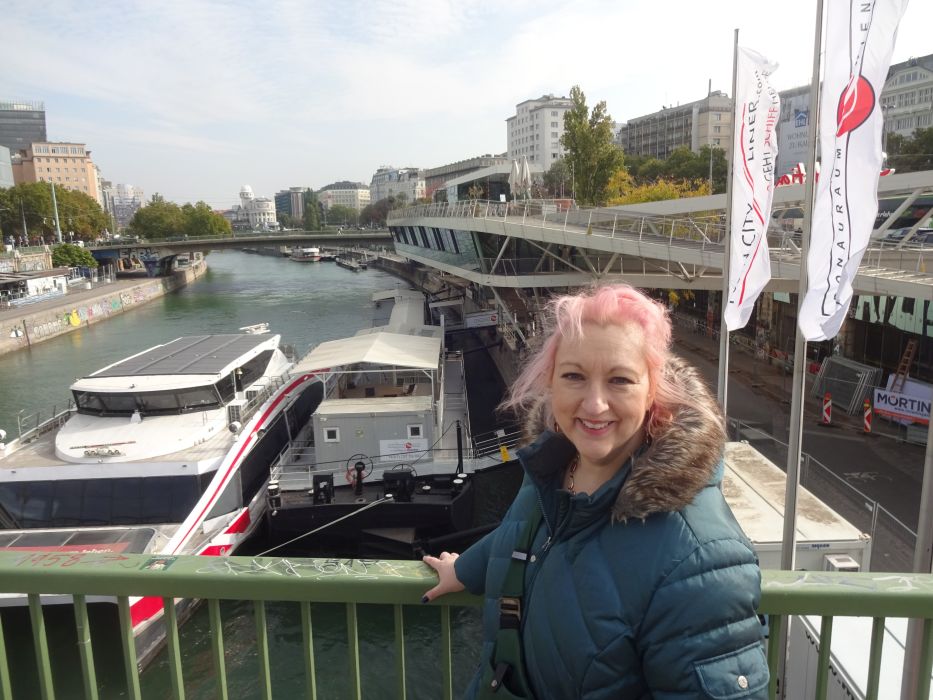
Rick Steves, who is a very well known travel show presenter here, gives this advice…
Rick Steves does not recommend taking a direct boat cruise immediately from Vienna to other areas along the river because the stretch right around and directly connected to Vienna is flat, industrial, and not scenic. [1, 2]
His core advice regarding Danube cruises includes:
- Direct Vienna Cruises Lack Scenery: Taking a boat straight out of Vienna (such as trying to cruise directly to Bratislava or long stretches immediately around the city) is uninspiring, flat, and mostly features trees and dull riverbanks rather than fairy-tale views. [1]
- Where the Danube Is Actually Romantic: Steves emphasizes that the Danube is at its scenic best west of Vienna—specifically through the Wachau Valley (between Melk and Krems/Dürnstein). [1, 2]
- The Recommended Way to Do It: Instead of a long, sluggish boat ride from Vienna, he suggests taking a train from Vienna to Melk (to tour the massive Melk Abbey), taking a boat or bike down through the scenic Wachau Valley (stopping at towns like Dürnstein), and then taking the train back to Vienna.
Then we set out to the Hundertwasser! This is a block of flats brilliantly coloured and decorative – to some degree Gaudi-esque – and its area around, Hundertwasser Village. Hundertwasser was an artist and architect who created the apartment complex in the 1970s to brighten what was then too grey and dull an area. There are even trees growing out of some apartments apparently, and the roof is wonderfully organic and shared between the occupants.
We’d read all about it in our guide. It’s a small area but enhanced by a funky little shopping and dining section opposite (where Marie got her necklace, and I a few postcards to frame).
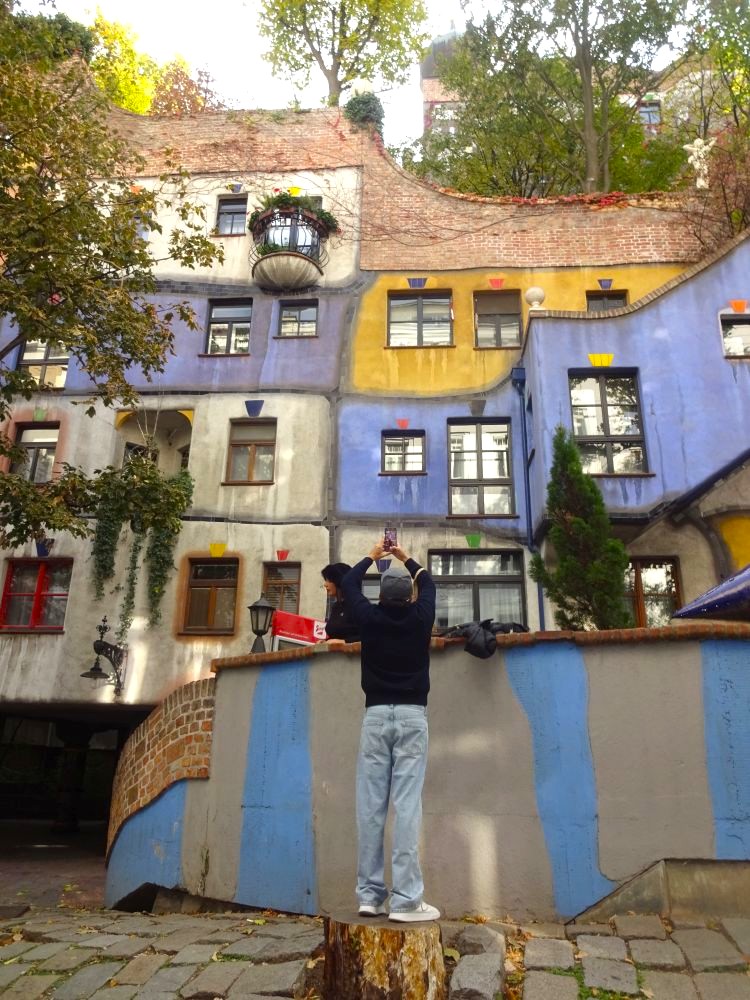
Hundertwasser
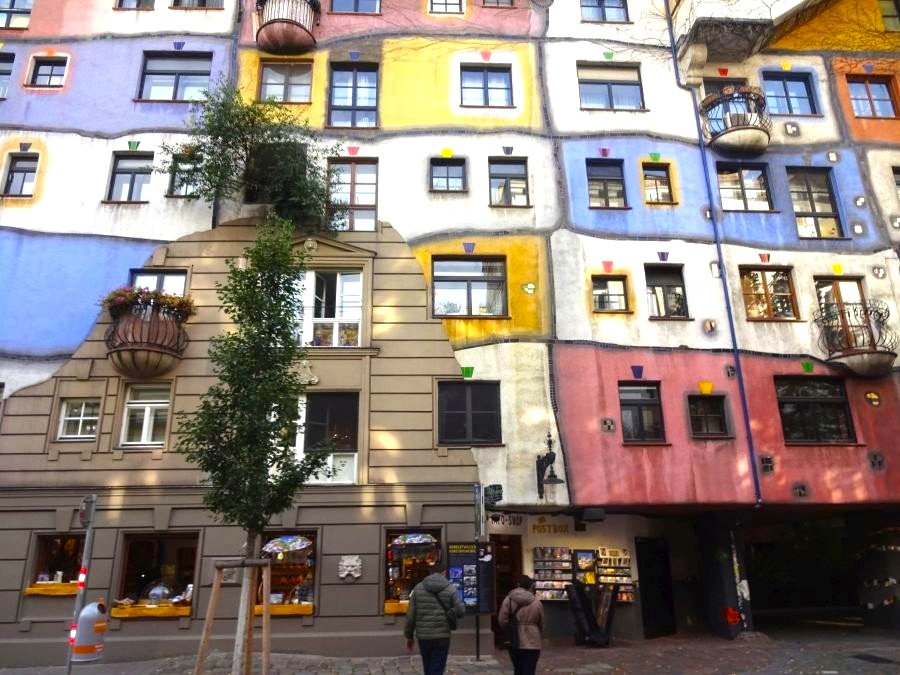
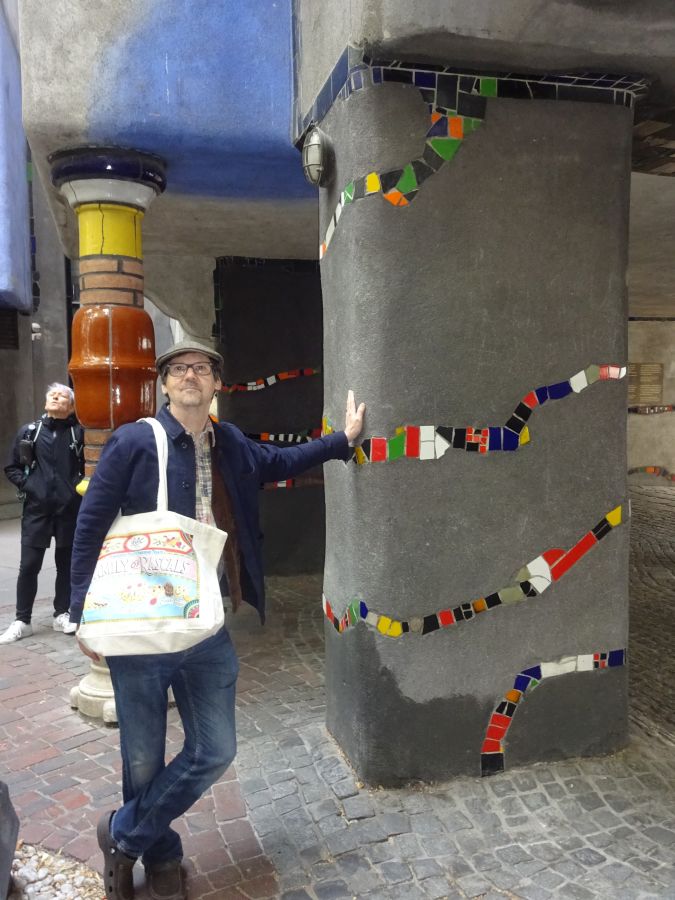
We enjoyed the humble hour very much – lots of photos – and followed it with a coffee and cake break at Strock on the corner.
Marie suggested we get on the tram that happens to take you through a lot of the city, just to see what’s going on. It was lovely, and we rode it past where we even intended to go and ended up in an area that everyday, less affluent people live on the outskirts. Somewhat like a Turkish Smethwick really! Getting rapidly back on track, and on to a reverse tram and into the picturesque city again and we got off at St. Charles Church and its small park. We walked the 24 minutes from there back to the hotel. A rest stop there at 5.30.
For tonight’s meal, Marie suggested Bastei Beise, which is very much a traditional Austrian family restaurant. We’d happened to pass it on the walk back. We loved it, and felt it was nearly all locals in there! No tourist frills, just a wonderful place.
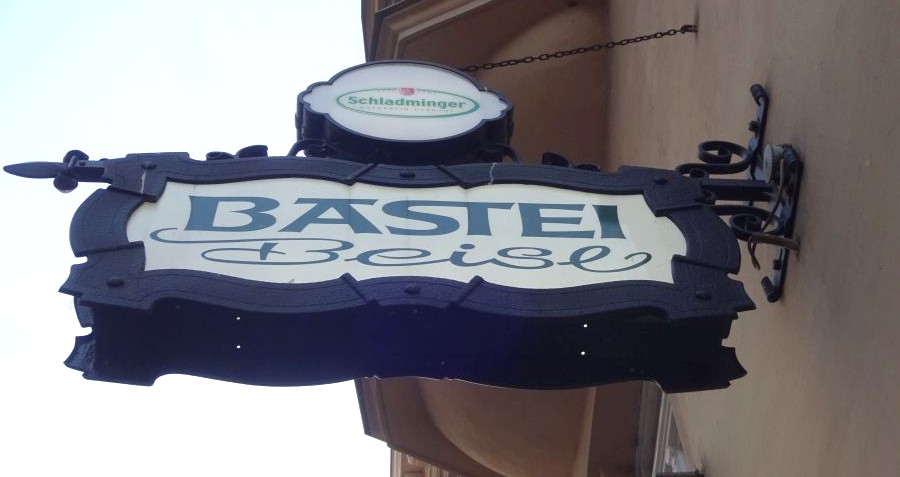
It seemed like the owner doesn’t speak English much but his daughter does and serves the non-Austrians who happened to go there. Marie had a small pork schnitzel (they have small options if you ask) and me a full size goulash with bread dumpling, soft fried egg and a small frankfurter. Both dishes tremendous. We finished by both of us requesting schnapps! The waitress seemed surprised but pleased as we ordered two including their house made one (much softer and fruitier than the other, full-on headbanger though it comes in small measures). It was served in a quirky glass.
We finished the evening at grand and plush Cafe Pruckel, another vintage, historical coffee and cakes place. On comfy sofas, a coffee for Marie and a hot chocolate with rum for me. From 1903, downstairs they’ve always had cabaret and comedy shows.
Day 4
We had originally intended to put one of the Vienna days aside to spend a day in Bratislava, an hour by train. What a great idea, you might say but we had decided instead to spend more time in Vienna but doing something quite different (rather than more city stuff, albeit a different country).
In our guide book back home, we’d read about the Heurigen.
A.I Bot Sarah says about it that “A Heuriger is a traditional Viennese wine tavern where local winemakers serve their own current-year wine alongside regional food in a rustic, relaxed setting”. From photos it looks beautiful and it is very much something you can do in October. To get there would be a tram, then a bus (Marie had done the research) and a deal of walking of which we don’t mind at all!
We brought back delicious breakfast from Offerl, and ate it in what I call the Common Room very close to our hotel room (really a lounge though). And we’d stopped at the much-loved “hole in a wall” Fenster to get coffee to bring back too.
We got the tram to a quiet, peaceful suburb of Heiligenstadt. We were surprised by the large apartment block, Karl Marx-Hof (“hof” roughly means courtyard in German). Apparently built in 1930 it still houses over a thousand apartments, and is a slight tourist attraction. As we know, Austria has never been Communist – rather the opposite in some ways – but Karl Marx was a major, respected figure in Austria.
Then onto very different scenery, as we walked up a small hill or two (nice but a fair bit of construction, Hungarian workers probably) and to a very quiet village where Beethoven lived for a while. The Beethoven Museum is there, though super quiet and there was just an old chap coming back with his shopping across the street. And we had just passed the first Heuriger – Mayer Am Pearrplatz. Beethoven himself had worked in the same tavern. I think it’s geographically the lowest contour of the hills and the first of about ten or twelve vineyard taverns you can visit.
You get used to a lot of buildings being very old and historic in Vienna (and later Salzburg, as we’d find…you start to think nothing of a bakery from the 13th century or a hotel from the 15th etc!).
More walking to a bus that would take up to the top of the high, rolling hills. Up and up, many hair pin turns and twists amongst lush countryside and through the occasional town you end up at a Viewing Platform and a cafe, a restaurant and part of a university. We went into the cafe, had a strawberry cream cake and drinks and took a lot of photos of the views below along with others!
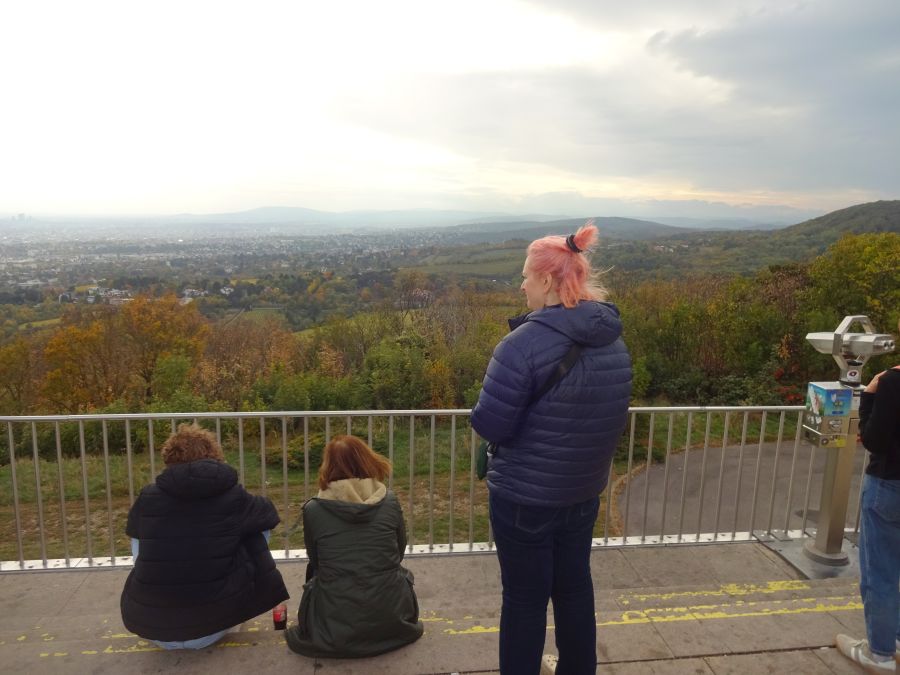
After that delightful break, we followed narrow roads and paths downhill for a mile or two until we found the Heuriger we were looking for, Sirbu (which gets great reviews). Weather was quite sunny, and everything wonderful. We loved Sirbu. So not showy in any way, you pick a seat at one of the wooden tables, if you’re feeling plucky help yourself to a few black grapes from the vines right next to the table – we did – then you go up a few steps into a little area at the back of the tavern where the owner (or manager) and staff sell you your choice of wine and whatever cold food you’d like. We chose a glass each of white and red and then two rose’s. The latter was especially excellent. We got mountain cheese, brie and bread and admired the views and just enjoying life up here.
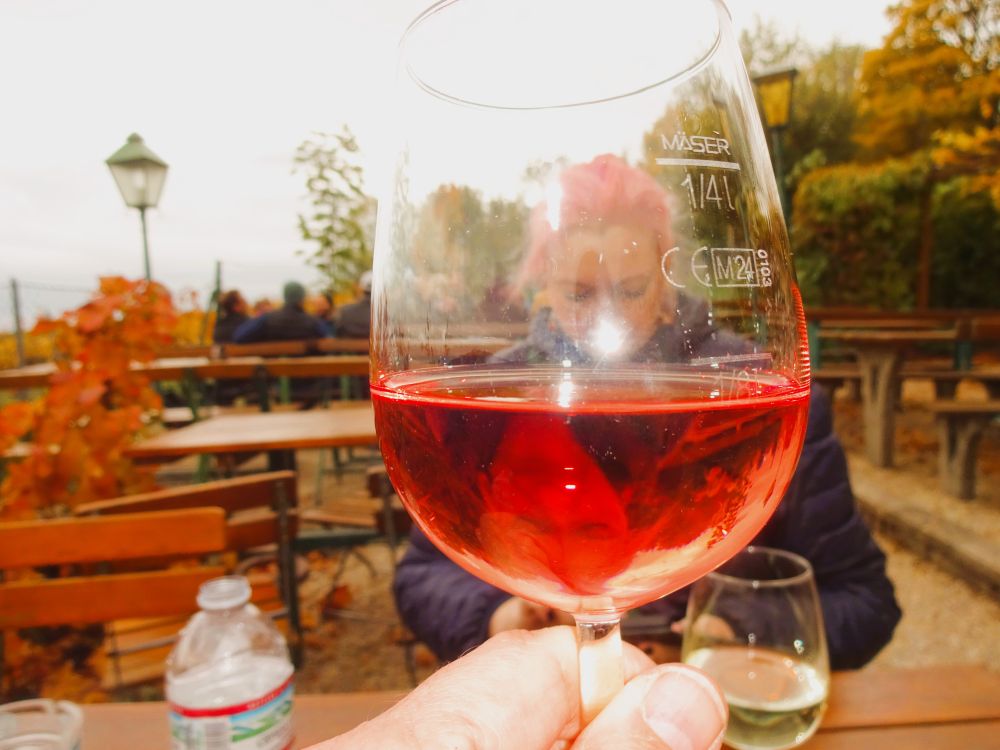
After a certain time there is no transport back, except a taxi, but Marie propelled us into a long and magical walk through the country and past other vineyards, cyclists etc and on and on until dusk. The only way is down roughly the way you came though and you can see the city down below in parts so you can’t go wrong! Some photos overleaf. It had been a longish but very enjoyable, and quite a not-at-all tourist kind of day…
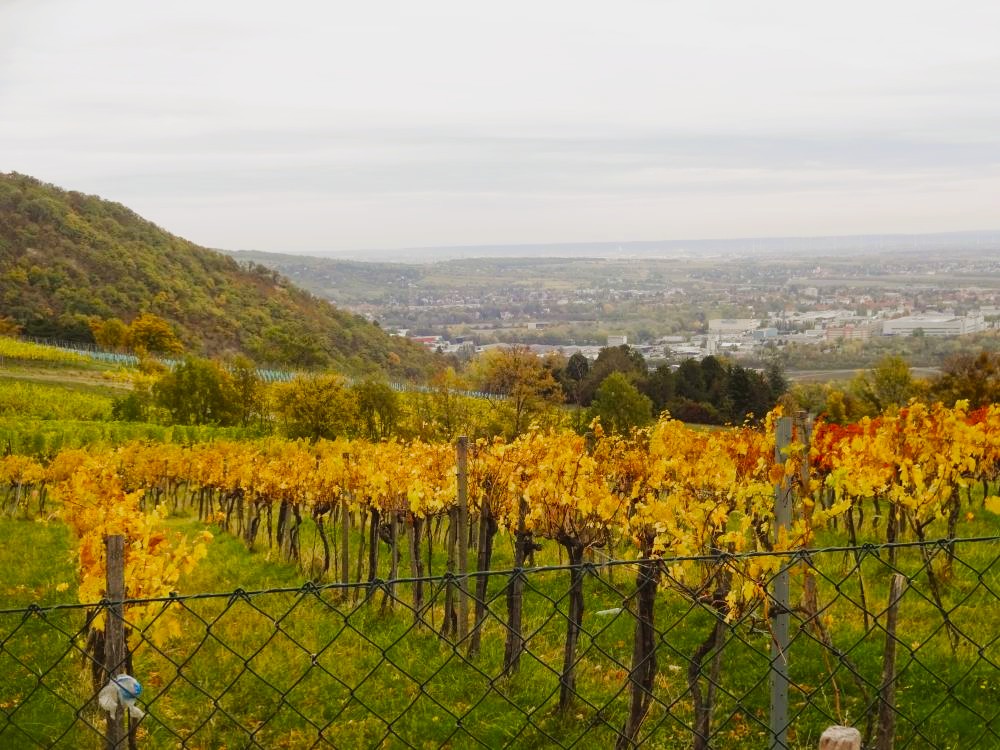
the view from our table
And finally to what I thought was a cafe in the city – Keine – but it was a little, old and terrific kind of bar really. For a last drink. We’d deserved it after a long, long walk.
Tomorrow would be our train to Salzburg!

